Tuesday, January 17, 2017

An Avian Melody: the Cardinal’s Song of Joyful Praise

This male Cardinal is taking a respite in our apple tree between trips to the feeder.

We enjoy feeding the birds year round, but in winter, when the surroundings can be rather drab, the Northern Cardinal certainly brightens the landscape. But these days it’s much more than simply watching the birds at the feeder. Watching the songbirds, particularly the wintering Cardinal, has raised questions. Is the Northern Cardinal, like others of the avian world, something more than simply a vividly-colored songbird? They forage, they procreate & raise their young. They do their utmost to survive, oftentimes in cruel and unforgiving elements. And still, they see fit to fill the air with a sweet melody.
A female Cardinal belts out a tune, much to our great delight.
The Cardinal’s cheery song is easily recognizable and while most songbirds are heard only during the mating season, Cardinals can be heard any time of year. The Cardinal’s delightful song is often heard while the songster itself remains hidden out of sight.
Such vivid imagery!
Other times they are spotted quickly thanks to a backdrop of blue sky. In the case of the Cardinal, such a contrasting background only serves to enhance nature’s palette.  
Winter serenity.
There once was a time when we didn’t give a whole lot of thought to their existence. Eventually, there came a day when we were perhaps more than a bit in awe of their ability to cope with and survive the harsh conditions of winter. Pondering this, it occurred to us that Cardinals, like all songbirds, are something special – a Godly handprint if you will, a gifted species of creation that sing of the majesty and wonders of their Creator and send their lavish praises skyward. One can't help but believe that perhaps they have ample reason for doing so.

“Look at the birds of the air, for they neither sow nor reap nor gather into barns; yet your heavenly Father feeds them”….. Matt. 6:26

Until next time,
Jim & Claudia

Monday, December 26, 2016

J.D. BARRETT: AVID PADDLER FOR ALL SEASONS

J. D. Barrett - has canoe, will paddle
J.D. Barrett sets out each year to match his age with the number of times he goes canoeing during the calendar year. Four years ago, at the age of 87 his 87th trip entailed paddling Black Creek as it flows through Genesee and Monroe Counties.  It was December at the time.  

Canoeing in December? Was there ice on the water? You bet, but not enough to deter J.D. and some well-wishing fellow paddlers who were on hand to help commemorate the occasion. On that day the group of seven launched their solo canoes in Churchville Park and paddled upstream a few miles before stopping for a celebratory hot lunch on shore.

The man in his element.
One might figure that given J.D. Barrett’s yearly quest, last year, at age 90, he would make ninety paddling trips on the waterways he so enjoys. Not quite. “God was willing” as J.D. might say, to see him complete 105 canoe outings on the lakes, creeks and rivers he favors. 

Some years J.D. meets his “quota” and other years, well, let’s just say age throws unforeseen snags in his path. This year shoulder problems prevented him from pursuing his outdoor endeavors as much as he would have liked. Still, he put in ample time both canoeing and fly-fishing.

Regardless of the weather, there's nothing better than being on the water.
In addition to paddling, J.D. has fashioned many a canoe and kayak from scratch and is well known for his custom paddles which he often presents as gifts to friends.  A skilled and meticulous craftsman, the time J.D. has spent making canoes and kayaks or helping friends do so is considerable, yet it is surpassed by the time he spends on the water in pursuit of one of his favorite pastimes. 

J.D. doesn’t spend all his time on the local lakes and streams or in his woodworking shop. A Stafford resident who is highly regarded in both the canoeing and fly-fishing communities, he has also been a member of Grace Baptist Church in Batavia for the better part of six decades.  In addition to serving as a deacon and on various committees, J.D. has used his musical talents as an accomplished pianist as part of the worship service for many years at Grace. 

The look of genuine contentment. 

A devoted family man, J.D. and his wife, Dorothy celebrated their sixty-ninth wedding anniversary earlier this year. To those who know him best, his attributes are many; good husband & father, adept canoeist, skilled fly-fisherman, talented musician, and a faithful servant of the Lord. A diverse and laudable repertoire indeed, one befitting a great American and a Godly man.

Until Next Time,
Jim & Claudia

Friday, December 9, 2016

The Voice of The Lord

Psalm 29:14 “The voice of the Lord is powerful; the voice of the Lord is full of majesty."

Have you heard the voice of the Lord?
From His throne on high He directs the world.
With a powerful voice full of majesty
He brings seasons of blessings for you and me.

In spring comes the rain to water the ground.
In fields and gardens new plants abound.
Cute baby animals are born every day.
God calls forth new life in so many ways.

In summer He brings forth the radiant sun
To warm the ground and everyone.
Summer flowers and beautiful skies
Rejoice the heart and delight 

In autumn God paints the leaves as the air turns cold.
Red, orange and yellow – beauty untold.
The harvest begins and His blessings we reap.
Animals tore food or get ready to sleep.

In winter God calls forth the ice and the snow.
We light warming fires; our faces aglow.
Children sled on hillsides of white,
Snow sparkles like diamonds in the bright sunlight.

Reflect on the ways you’ve heard God’s voice;
Sounds that bring peace and help you rejoice.
A world full of wonderful sights on display
To call forth our praise and worship each day

(Poem courtesy Sally Barrett Fry)

Until Next Time,
Jim & Claudia


Tuesday, November 22, 2016

An Evening Paddle on the Tonawanda


Serenity can be found just steps from our back door.
Because it borders our property, we’ve paddled Tonawanda Creek more than any other local stream during the past three decades. While anytime we get the opportunity to paddle together is a good time, it’s during the fall months that we most enjoy being on the water. During the last half hour of daylight is an especially magical time, as day fades into night. It is then, as darkness slowly permeates our surroundings that the sounds of the nocturnal denizens penetrate the still of the evening – perhaps the trill of a Screech owl or the loud splash of a beaver sounding the alarm.

It's at about this time – on ultra clear nights - stars will start appearing overhead. There'll be one or two at first while there is yet a faint orange flow on the horizon, then, as the heavenly recesses become inky black, the night sky suddenly resembles a celestial display of diamonds scattered on black velvet. At such times I'm reminded of a passage from the Book of Psalms….”The heavens are telling of the glory of God; And their expanse is declaring the work of His hands.

"He leadeth me beside still waters....."
Whether paddling night or day on a slow-moving stream, this autumn has been nothing short of spectacular, and a great season for seeing first hand an awesome display of God’s Handiwork.

Until Next Time, 
Jim & Claudia


Thursday, September 29, 2016

The Dragonfly - A Stealthful Hunter


A Twelve Spotted Skimmer alights on a Spiraea twig.
Fascinated with nature at an early age, I spent a great deal of time in my formative years inspecting insects. Those most readily available and easy to catch were crickets, grasshoppers and sow bugs. Among those not so easy to catch were dragonflies and back in those days, nobody I knew wanted to catch one anyway. There was a reason for that.
 
None of the other kids from my neighborhood called them dragonflies. They called them “darning needles” or “sewing needles” because it was rumored that they had the ability to sew your eyes, ears or mouth shut. While I may not have fully believed that story as a lad there was probably a time or two when, if I did happen to see a dragonfly while outdoors, I kept a wary eye on it until it flew out of sight. Over the years, as my outdoor horizons expanded, my interest in dragonflies also grew and I discovered that, like all creatures of the wild, the Good Lord saw to it they came equipped to take care of themselves.  For example, they do have incredibly sharp mandibles, but use them only for capturing prey, not to sew little boys eyes and ears shut.

Truth be told, all dragonflies, like the Whitetail seen here, are no threat to humans.

A sighting of the Bluet Damselfly often harkens one back to summer days gone by.

The Bluet as seen above, was a frequent “visitor” in my early years, especially if I was fishing. It seems like whenever I was wetting a line, they would land on the tip of my fishing pole and be content to stay a while if left undisturbed.    
The Jagged-Edge Saddlebag is so named due to the
tell-tell markings along its thorax.
Despite the delicate look of a dragonfly's gossamer-like wings, they provide it with maneuverability unequaled in the insect world. They possess two pairs of wings, and can operate each wing independently of the others. They can fly forward, backward and even sideways and hover in one spot for an indeterminate amount of time.  This unique trait in the flying insect kingdom is one of the primary reasons they are such skillful and stealthy aerial hunters.   
The dragonfly's bulbous eyes give it outstanding vision.
A dragonfly's field of vision is nearly 360 degrees, with its only blind spot directly behind them.  Their compound eyes consist of 30,000 facets – or “smaller eyes” each of which provides information regarding the dragonfly’s surroundings. Combine their extraordinary vision with their flight skills, and you have a predator that can either intercept or ambush its intended prey in mid-air without slowing down and, thanks to those sharp mandibles, consume it while still on the fly.  

In this instance, the hunter became the prey.
Despite their being skilled predators, likewise the dragonfly is preyed upon by a number creatures including but not limited to fish, birds, mammals, reptiles and spiders. Pictured above is a Black-and-yellow Argiope spider wrapping a Red Skimmer in a silk cocoon for a later meal. Bon Appetit!       

Until Next Time,
Jim & Claudia                                                                               


Wednesday, September 21, 2016

Fluttering Gems of Late Summer

Often mistaken for a Monarch, this is the Viceroy.
It is distinguishable by the arched black line that crosses the hind wing.
It's late summer and fallow fields and meadows are awash with the color of wildflowers. Likewise, roadsides and hedgerows are speckled with the brilliant hues of goldenrod, purple asters, and chicory to name a few.  

While this landscape is aesthetically pleasing to the eye and enjoyed by many, perhaps nothing appreciates those colorful wild blooms more than butterflies. The weather has been nothing short of spectacular and it stands to reason that this is perhaps the greatest time of year for watching a wide variety of butterflies as they flit and flutter from flower to flower, drawing nectar from bloom after colorful bloom. With that in mind, we thought it a great time to share with you some of our favorite butterfly photos.
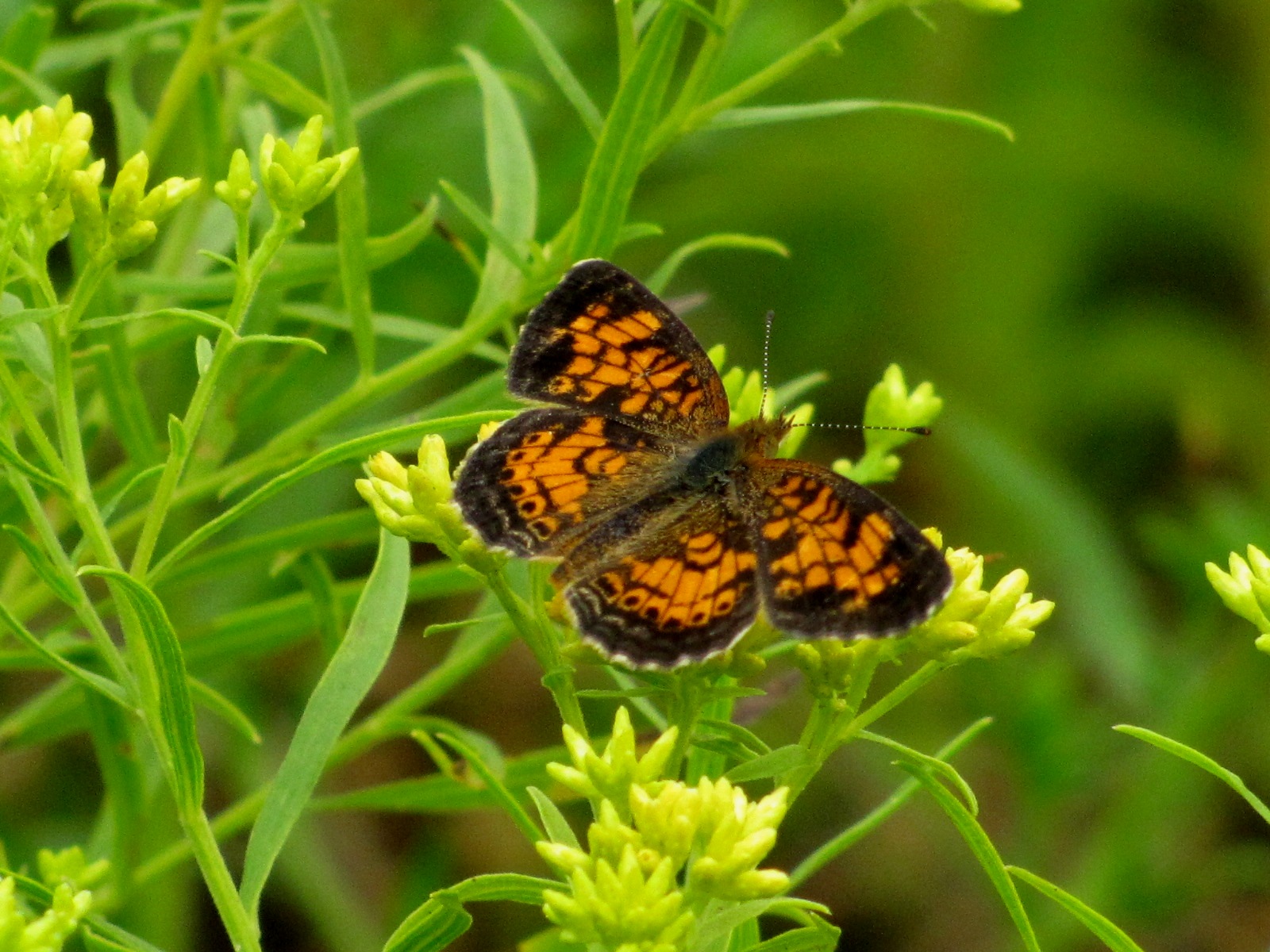
This is a Pear Crescent, one of the more common smaller
 butterflies, seen here alighting on some goldenrod.
A Question Mark touches down by the side of the road at Genesee County Park and Forest. This species is so named for the silver marking along the base of its rear wings.
A Mourning Cloak absorbs some mid-morning sunshine. Some believe
 its named for its somber color, much like a funeral shawl worn by widows. 
Flower gardens are equally attractive to butterflies this time of year.  We especially enjoy gazing upon our butterfly bush while it's in bloom to see the variety of visitors it attracts.  

An Eastern Tiger Swallowtail is busy at work pollinating the tiny
individual blossoms of our butterfly bush.
A White Admiral also enjoys visiting our yard.
While butterflies might not be as fast or efficient as bees when it comes to pollinating, they certainly are a pleasing sight to behold.  Plus, when was the last time anyone got stung by one?

Until Next Time,
Jim & Claudia

Sunday, August 21, 2016

Nonmetaphorical Snakes in the Grass

A close-up of the 2nd largest Northern Water Snake I've ever seen.  
I had my first snake encounter as a youngster in the early fifties, before I ever entered kindergarten. Not knowing what a snake was at the time, I received my intro to reptiles courtesy of a Northern Water Snake along the shore of Little Tonawanda Creek. As a result I became fascinated with snakes for a number of years, and while that fascination has waned a great deal, a water snake never fails to arouse my curiosity. 

Last week I was able to relive that very same first experience.  What began as a nature outing with my grandsons in pursuit of frogs, dragonflies, grasshoppers, etc. turned into something else entirely when my youngest grandson yelled, “Snake!”.  We watched them intently for a time and then set off for more exploring.  

The following morning I decided to return to the same spot alone that we had been the day before, this time with camera in hand in the hopes that some picture taking opportunities would arise, and did they ever!   

This is the same snake, its crossband markings quite vivid, with
 alternating dark blotches stretching from its neck all along its back and sides. 
I had taken several photos when I happened to look down and received quite a surprise. Hardly more than a foot way was a second snake and although its head and tail are hidden, it was easily the largest Northern Water Snake I’ve ever seen. It is looped rather than coiled and as is the case with older water snakes, this one’s pattern has all but faded, giving it an all black or dark brown appearance.   
This is the sight that greeted me when I happened to glance down to my right. 

By now I’m both surprised and curious, and I was intent on locating the head of this jumbo water snake. While trying my utmost to keep my feet stationary and perfectly still, and in the process doing a good impersonation of a contortionist, I twisted and turned my torso trying to locate the head of the second snake in the tall grass. I managed to locate the head of the larger snake and, as you can see, there are no vivid markings, its blotched pattern has definitely faded with age. It is massive for its species.


The milky, opaque coating over the eye indicates the snake is getting ready to shed.  
I was puzzled.  Three mornings in a row both snakes were located in the same location well away from their preferred habitat. There was a pond to the north, maybe twenty yards away, and a small, sluggish stream, forty yards to the south. Judging by the size of these water snakes, their habitat provides a readily available menu, one that is vast and varied. Both locations have frogs, fish, crustaceans and other critters that water snakes readily feed on. But instead, both snakes had stayed away from obvious food sources and stayed put in the grassy meadow and always in very close proximity to one another.  

Could this be the reason for the "snakes in the grass"?
There is one possible explanation I can think of. Each year the meadow and its tall grasses serve as a nesting site for dozens of Bob ‘o Links (pictured above) and a few other songbirds that nest on the ground. I can’t help wondering if, come nesting season, this pair of large and aged Northern Water Snakes take up residence in the meadow – at least on a part time basis – in a quest for bird eggs – a reptilian delicacy.  

Until next time
Jim & Claudia