Wednesday, April 20, 2016

Some Sights and Sounds of Springtime

A Red-wing Blackbird alights upon a Red Osier Willow.
Among the first arrivals of our feathered friends early last month was a large contingent of Red-winged Blackbirds. While their song is easily recognizable and a sure sign that spring is nigh, it seems this year neither they nor our local meteorologists could agree as to when exactly spring should kick into high gear.

Environs such as this are a spring peeper paradise.
There is no sweeter springtime sound than that of the small chorus frog, commonly known as the "peeper". Their mating season was underway weeks ago and, providing the air temperature doesn’t drop significantly, you will hear their springtime cacophony day or night.

A wood frog warily eyes its surroundings.
It may be the spring peeper whose chorus we are most familiar with, but it’s the wood frog who is usually heard from first. Its raspy call is heard in early spring, often before ice has completely melted.  They are at the lower end of the locally indigenous creatures food chain, often falling prey to just about every other bird, mammal, and reptile they have the misfortune of being spotted by.         

This vernal pool will provide a wonderful micro-environment habitat.
A vernal pool such as the one pictured above is seasonal, perhaps lasting no more than a month or two, depending on the weather. The Spring Peeper and the Wood Frog, as well as certain species of turtles, salamanders, etc., are all reliant on these pools to procreate. They come here to breed, deposit their egg masses and then go back to whence they came. And they don’t necessarily live in close proximity.


Like waterfowl, the aforementioned creatures also have a need to migrate – they just don’t do so on such a grand scale as the birds of the air.  They may simply have to cross a variety of terrain (as well as a dangerous road or two) to get to said place because their biological clock, as well as their ancestral DNA tells them so.  While in our midst however, let us take the time to enjoy their springtime songs of love to one another.

Until Next Time,
Jim & Claudia

Tuesday, April 5, 2016

A Strange Visitor From Afar


The Horned Grebe is a rather unique creature. For the most part, they breed on freshwater lakes and marshes from Canada’s Prairie Provinces northwest to Alaska and, come fall, nearly the entire population moves to the coast. They migrate nocturnally and after reaching their wintering grounds, they seldom fly.  So it was more than a bit of a surprise and a real treat to find a Horned Grebe cavorting and diving for small fish in our flooded backyard after the Tonawanda Creek spilled its banks a couple of winters ago

There are numerous species of grebes but the Horned Grebe is thought to be tamer than the rest, allowing a closer approach by humans. This fellow didn’t seem to mind our presence one bit, allowing Claudia to take a number of photos while he swam about non-stop, diving at random and, after having stayed submerged for several seconds, would pop up like a cork. More often than not it was successful in finding small fish in the murky floodwater.


"I'm watching you, watching me,"

As seen in this photo, the Horned Grebe’s deep-red eyes are connected to its bill by a thin line and may play a role in locating prey in dark and dingy water. They are excellent swimmers and the young are able to swim immediately after hatching but mostly they hitch a ride on their mother’s back. 

Down the hatch!

By tilting its head slightly, the Horned Grebe allows its finned prey to easily slide down its gullet. More at home on the water, they feed mainly on fish, crustaceans and aquatic insects.  Unlike ducks which are content to sit motionless if undisturbed, the Horned Grebe is perpetual motion, constantly on the move when on the water.  


Still sporting its winter plumage, the “horns” for which this species derives its name are actually tufts of feathers located behind and slightly above its eyes. The russet-colored “horns” will become much more prominent during breeding season at which time the Horned Grebe’s neck will become rufous (reddish-brown) and the plumage along its back will darken considerably.

The solitary bird spent the better part of that weekend with us. We first spotted him around noon on a Saturday and for the entire time – during daylight hours anyway - he was constantly on the move, alternately swimming and diving for food. He must have been fueling up for the next leg of his journey as he was gone by first light on Monday morning.  

Until Next Time,
Jim & Claudia

Saturday, March 26, 2016

He is Risen!

Easter Weekend is upon us.  As we venture outside reminders can be found everywhere as Nature itself reaffirms the significance of these very special days.  

A crocus, having been entombed below ground, becomes
 one of the first newly emerged flowers each spring.

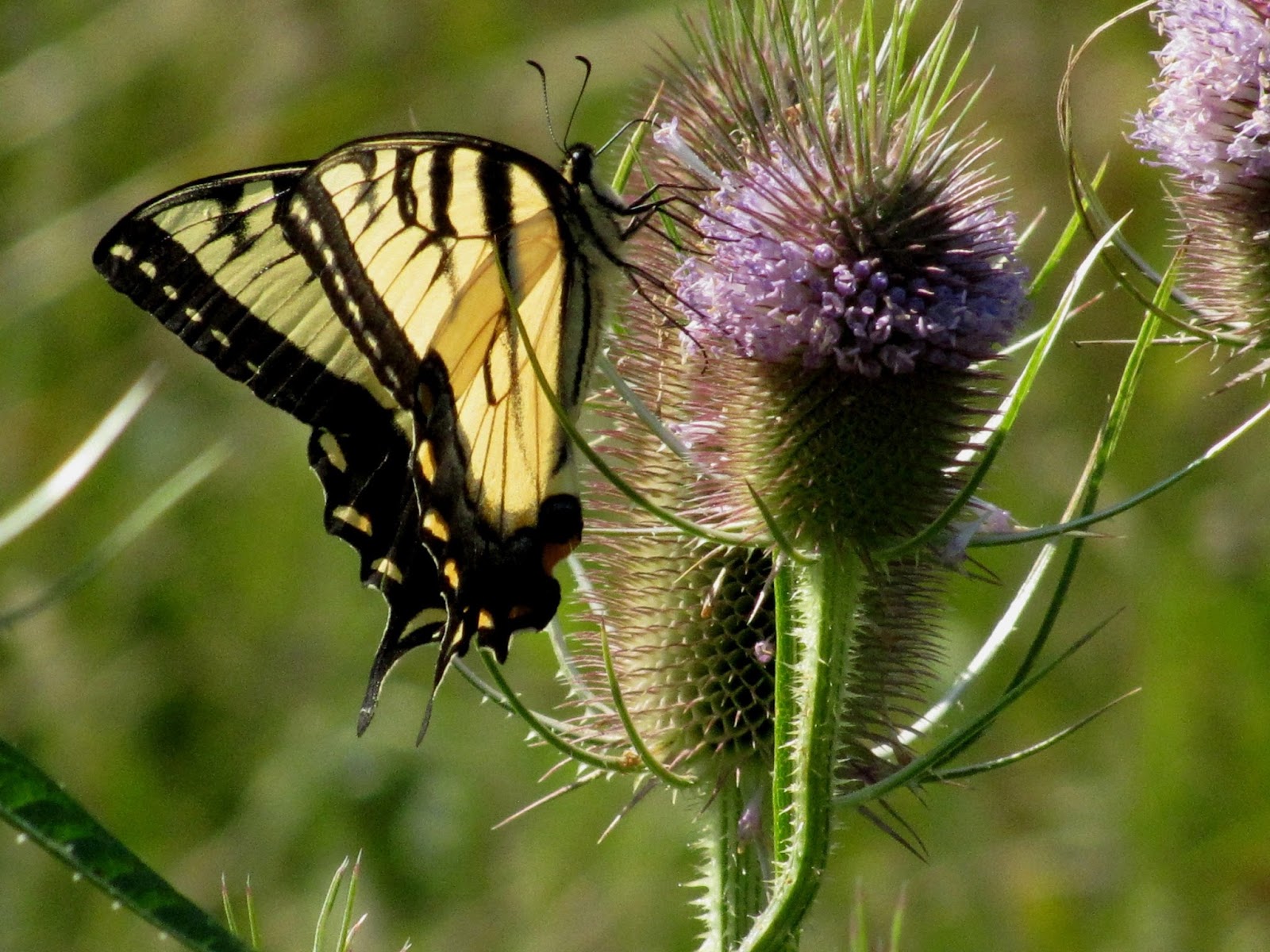
Once a caterpillar relegated to the move along the ground at a 
snail’s pace, this Eastern tiger swallowtail now free of its cocoon
 sports a pair of wings and flits about where it pleases. 

These rays of sunlight bring to mind the angel rolling the stone away
 from the tomb and revealing the brilliance of Christ’s glory.

And the sunrise……a foreshadowing of things to come, 
a daily reminder of the promise of Jesus Christ.


It is true.  He has risen, just as he said He would.  

Until Next Time,
Jim & Claudia

Thursday, March 17, 2016

The Tundra Swan


A creature both sublime and graceful, I would be hard pressed to come up
with a more ideal display of majestic beauty than the Tundra Swan in flight. 

Our mild winter has jump-started the spring bird migration here in eastern North America, and among our many avian friends that are winging their way Northward is the strikingly magnificent Tundra Swan.  They will stop here briefly before heading to their breeding grounds in the Canadian Arctic. Come autumn, they’ll make the return trip to their wintering grounds along the Atlantic coast, traveling as far as South Carolina. That’s a one-way flight of nearly 3500 miles and it’s a trip they make twice a year.

Believed to mate for life, Tundra Swans pair up for nearly a year
 before the mating process begins
.

With breeding season drawing near we begin to see
 fervent displays of affection and courtship.

Their "heart" of love for one another is on display for all to see.

Having taken a much needed respite on a farm field in Pembroke, these
 Tundra Swans are again taking to the skies en route to the far North. 

I derive a good deal of enjoyment from nature, both in the beauty found therein and its awe-inspiring moments. But even more than that, I’ve learned to appreciate it's stark reality – a world unto itself that’s as real as it gets - no hidden agendas, just a biological drive to procreate and sustain the species’. Having gazed upon the Tundra Swans and listened to their calls, it would appear that a good deal of affection certainly helps the process.  As Job reminds us; Just ask the animals and they will teach you.  Ask the birds of the sky and they will tell you. Speak to the earth, and it will instruct you. In His hand is the life of every creature.  My eyes have seen all this.  My ears have heard and understood it.  

Until Next Time,

Jim & Claudia

Sunday, March 6, 2016

The Cycle of Life

Several years ago during the late summer, my morning walk took me along the old Lehigh Railroad bed just South of the Batavia city limits.  That particular section is elevated about 15’ above the land on either side. On the North side of the tracks is a small wetland known locally as the “beaver swamp.” To the South, and directly below me was a fairly dense thicket consisting mostly of osier, wild grape vine and various small trees. Despite my vantage point from above, I wasn’t afforded much of a view other than the top of the thicket. As it turns out, I had all the view I would need.      

Moments later there was a flash of movement below me and to my left. A Cedar Wax wing was making haste through the tops of the scrub growth with a Cooper’s Hawk in hot pursuit. They passed by practically within spitting distance traveling in the opposite direction. I don’t know what the outcome was but the hawk matched its intended quarry move for move until they disappeared from sight.   

I photographed this Cooper's Hawk at the Iroquois National Wildlife Refuge.

If ever there was a raptor built for maneuvering through the woods at high speed, it’s the Cooper’s Hawk and his look-alike cousin, the slightly smaller Sharp-shinned Hawk. Some birds of prey, like the Northern Harrier, glide low over the terrain in search of a meal, while some, like the Red-tailed Hawk hunt by circling high overhead or from a lofty perch. Once having spotted their quarry, they will make a rapid nose dive before pouncing on their unsuspecting victims. Not so with the Cooper’s hawk.  Their diet consists of mainly smaller birds which they chase down with relentless pursuit, zipping through the woodlands, performing sleek aerial maneuvers as they evade tree limbs, tangles and brush all while staying solely focused on their prey. 

 Despite my attempt at concealment, he’s been aware of my
presence, eyeing me warily the entire time.
  

Deciding whatever it is that’s watching him is not something to eat,
and in 
the blink of an eye, he'll be gone.

Cooper’s hawks don’t confine their hunting to the wild. Smaller hawks have been known to hunt in residential areas, particularly when bird feeders offer up an easy meal.  We enjoy the many colorful songbirds that are drawn to our yard, yet we’re aware they make up a large portion of the Cooper’s hawk’s diet. On occasion we are reminded of this sober truth upon coming across the tell-tale clusters of Blue Jay and Northern Flicker feathers lying on the ground and it is then that I am drawn to Ecclesiastes 3; There is a time for everything, and a season for every activity under the heavens.  A time to be born and a time to die, a time to plant and a time to uproot, a time to kill and a time to heal, a time to tear down and a time to build, a time to weep and a time to laugh, a time to mourn and a time to dance……….

So goes the cycle of life, all according to His plan.

Until Next Time,

Jim & Claudia

Wednesday, February 24, 2016

Backyard Visitors

We’ve been blessed with a prolific number of songbirds stopping by for a "visit" with us this winter.  The nearby trees and feeders have been a virtual cornucopia of avian color and song; cardinals, chickadees, nuthatches, blue jays, woodpeckers, juncos, goldfinches, even a bluebird or two have all spent some time with us recently, and that’s only a partial list.    


As demonstrated by this young male cardinal, even birds can have "bed head".


A downy woodpecker samples the suet during last week’s snowfall.


This nuthatch just might be wondering where all the suet went that the woodpecker
told him about the previous day.

With no worms available just yet, this early robin samples a Sumac drupe.


In the winter months, the goldfinch sports feathers that are a paler shade of yellow than what we are accustomed to seeing in the spring and summer.
 
A red squirrel dines on a walnut taken from its winter food cache. Like the songbirds, the bushy tails spend most of their daylight hours foraging for food.


Though we already have a wide variety of songbirds close at hand, with the onset of spring and warm weather the number is sure to grow.  As might be expected, with such a variety of wildlife in close proximity to our home, it's only natural that we get other visitors as well – those seeking to make a meal of our feathered and furry friends alike. We’ll tell you about them next week. 

Until Next Time,
Jim & Claudia

Sunday, February 14, 2016

His Eye is on the Sparrow

Living in Western NY means experiencing the joy of four distinct seasons. For us, one of the more glorious aspects during this time of year (besides not having to rake leaves) is the lack of foliage in winter, thus allowing Claudia & I the ability to gaze into the woodlots nearest our home. Cottonwood, Walnut, Box Elder and White Ash, just to name a few, all reach toward the sun, beckoning to an abundance of avian wildlife to find respite amidst their branches. 
 
Here a Red-bellied woodpecker stops hammering away in its search for insects long enough to have its picture taken.

 
A pair of mourning doves rest in the barren branches of a walnut tree.  These two will likely be a monogamous couple for life.


Sampling the spillage from our bird feeder, a chickadee helps itself to a sunflower seed. A trusting and friendly sort, the chickadees on occasion have taken seed from our hands.


A female cardinal belts out a tune. Unlike most songbirds that sing only during the spring mating season, the male and female cardinal may be heard any time of year.

This past week especially, I couldn’t help but give a good deal of thought to how our feathered friends deal with the extreme cold. They just fluff their feathers and without complaint, go about their business as usual. Watching them in the bitter cold, I’m reminded of an old and favorite hymn; “His Eye is on the Sparrow”. Sure does seem that way….Amen!

Until Next Time,
Jim & Claudia